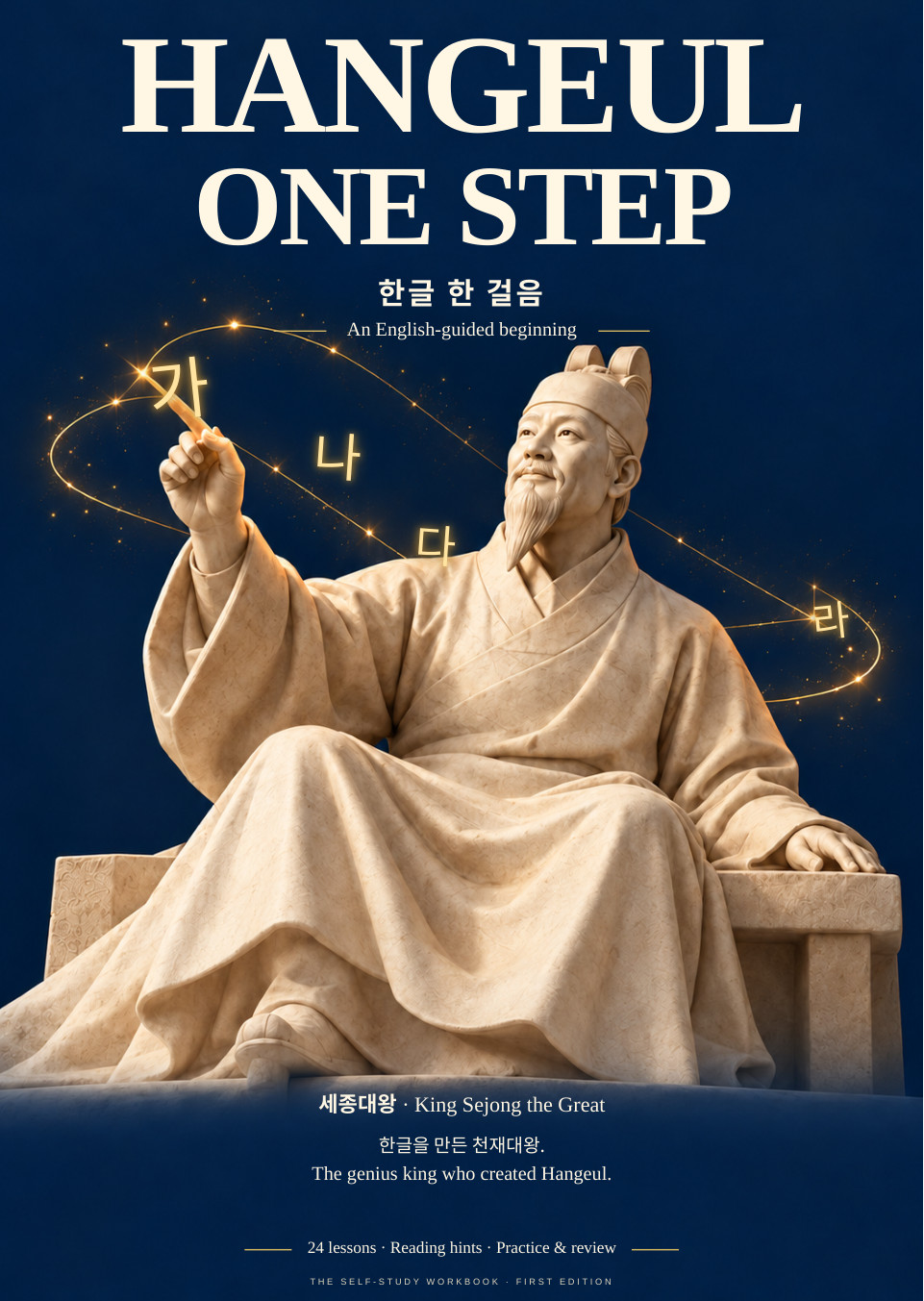
Start with two small steps.
READING HELP · 받침 [bat-chim] means a final consonant. Roman-letter brackets help you start: eo and eu each represent one vowel; hyphens show syllables. These are approximate hints. Listen to Korean audio and gradually cover the hints when practising.
Try these lessons and check your answers. The complete 24-lesson workbook is a paid PDF.
Lesson 01 · Your first syllable block
Start here: Make one block from two letters.
Do one thing · 1 minute · open: Copy 아 [a]. Cover it and write it again. Point to ㅇ and ㅏ. Model to check: ㅇ + ㅏ → 아 [a].
Goal: Build 아 [a] and count syllable blocks.
VISUAL LAB · 01
READING HELP · 아 [a]
Hangeul is the writing system used for Korean. Its letters fit together in small blocks. A block normally represents one syllable, or spoken beat.
Look at 아 [a]. It contains two letters: ㅇ + ㅏ → 아 [a]. The circle is on the left. The vowel is on the right. Together, they make one block.
At the beginning of 아 [a], ㅇ has no consonant sound. It holds the first position so the vowel can begin the syllable. Final ㅇ has a different sound; you will meet it in Lesson 04.
For ㅏ, open your mouth comfortably and keep your lips unrounded. Aim for one steady vowel. Korean audio will help you learn its sound; an English word is not an exact sound guide.
Read blocks from left to right. 아이 [a-i] means “child”: 아 [a] | 이 [i], two blocks. Write the word 아이 [a-i] without a space between its syllables. You will learn 이 [i] next.
Remember: 아 [a] = two letters, one block. A later block can also have a consonant at the bottom, called 받침 [bat-chim]. You will practice that in Lesson 13.
Try it · visual
- L01-A1: How many blocks are in each item: (a) 아, (b) 아이, (c) 미나? Count blocks, not strokes.
- L01-A2: Choose the correct statement: (a) 아 has one written letter; (b) 아 has two written letters in one block; (c) 아 must be written as two separate blocks.
- L01-A3: Which is the correct assembled block for ㅇ + ㅏ: 아 or 어?
- L01-A4: In 아, does beginning ㅇ add a consonant sound: yes or no?
Make a mark · open
Draw four squares, about two centimetres wide. Copy 아 [a] into the first three. Keep ㅇ on the left and ㅏ on the right. Cover the model and write the fourth from memory.
Self-check: Both letters fit inside one block. The circle is closed and ㅏ points right.
Tomorrow’s retrieval: Build 아 [a] from two letter cards. Explain why its beginning ㅇ is silent.
Lesson 02 · Three upright vowels: ㅏ ㅓ ㅣ
Start here: Notice the short line before you read.
Do one thing · 1 minute · open: Copy 아 [a] · 어 [eo] · 이 [i]. Cover the row and rebuild one block of your choice. Model to check: ㅇ + ㅏ → 아 [a]; ㅇ + ㅓ → 어 [eo]; ㅇ + ㅣ → 이 [i].
Goal: Tell 아 [a], 어 [eo], and 이 [i] apart.
VISUAL LAB · 02
READING HELP · 아 [a] · 어 [eo] · 이 [i]
First, look at the short line:
- ㅏ: short line points right.
- ㅓ: short line points left.
- ㅣ: no short line.
These vowels sit to the right of the first consonant. Add silent beginning ㅇ: 아 [a] · 어 [eo] · 이 [i]. Keep each pair of letters inside one block.
Now try the mouth shapes. For ㅏ, open your mouth with unrounded lips. For ㅓ, keep your lips unrounded and make the vowel farther back in your mouth. For ㅣ, raise the front of your tongue and keep the sound steady.
Keep ㅓ and ㅗ separate: ㅓ has unrounded lips; ㅗ has rounded lips. You will practice ㅗ in the next lesson. These Korean vowels do not exactly equal English vowel sounds. Use Korean audio when you can.
Read this short row slowly: 아 [a] · 어 [eo] · 이 [i]. Check the short line before reading each block. Then try 이 [i] · 아 [a] · 어 [eo].
One useful word: 아이 [a-i] = child, written as two blocks: 아 [a] + 이 [i].
Try it · visual
- L02-A1: Complete the blocks: (a) ㅇ + ㅓ → __, (b) ㅇ + ㅣ → __, (c) ㅇ + ㅏ → __.
- L02-A2: Select every 어 in this row and give its position number: 아 · 어 · 이 · 어 · 아.
- L02-A3: Match the feature to a vowel: (a) no short side line, (b) short line to the left, (c) short line to the right. Choose from ㅏ, ㅓ, ㅣ.
- L02-A4: Split 아이 into its two syllable blocks with a vertical line.
Write and retrieve · open
Copy ㅏ ㅓ ㅣ once, then cover and write them again. For ㅏ, draw the long line, then the right stroke. For ㅓ, draw the short left stroke, then the long line. For ㅣ, draw one downward stroke. Now write 아 어 이 [a eo i].
Self-check: The short lines face the right way. Each vowel has a beginning ㅇ in its full block.
Tomorrow’s retrieval: Write 아 [a], 어 [eo], and 이 [i] in a new order. Check the short lines.
Sample answer key
L01-A1: (a) 1; (b) 2; (c) 2. L01-A2: (b). L01-A3: 아. L01-A4: No. Beginning ㅇ in 아 supplies no consonant sound.
L02-A1: (a) 어; (b) 이; (c) 아. L02-A2: Positions 2 and 4. L02-A3: (a) ㅣ; (b) ㅓ; (c) ㅏ. L02-A4: 아 | 이.
Download the illustrated free sample PDF ↗
Personal study licence: no unauthorised sharing or resale. See the purchase terms.